


Over the coming months, we're exploring six qualities we intentionally nurture every day in our classrooms because we believe they shape not only successful learners, but kind, capable, and resilient people. Each month, we take a closer look at one of these qualities and why it matters far beyond the early years.
Our last blog explored curiosity and how a child's natural desire to understand the world becomes the foundation for meaningful learning. This month, we're looking at something closely connected, but often misunderstood: focus.
If you've ever watched a young child become completely absorbed in building a tower, arranging their toys, or examining a tiny insect, you've probably noticed something interesting. The same child who struggles to sit through a short conversation can spend an astonishing amount of time on something that captures their interest.
We often hear that young children have short attention spans. And while their ability to concentrate is still developing, perhaps the more interesting question isn't how long children can pay attention, but what allows their attention to settle in the first place.

What Is Focus?
We tend to associate focus with sitting still, listening carefully, and following instructions. A child who remains quiet during an activity may appear focused, while one who moves around or becomes distracted may seem to be struggling with attention.
But stillness and concentration are not necessarily the same thing.
A child can sit quietly while thinking about something entirely different. Meanwhile, another child may be deeply engaged in an activity that involves movement, conversation, or repeated experimentation.
True focus is less about controlling a child's behaviour and more about their ability to become genuinely absorbed in what they are doing.
And here's something worth considering: children often concentrate most deeply when they have a sense of ownership over their activity.
When children choose something that interests them, understand what they're trying to accomplish, and have enough time to become involved, their attention has a natural reason to stay. They aren't concentrating simply because someone has asked them to. They're concentrating because the experience matters to them.
This changes how we might recognize focus in young children. Rather than looking only for quiet behaviour or completed tasks, we can begin noticing the quality of their engagement: the care they bring to an action, the details they notice, and the thoughtfulness that emerges when they become truly involved.
Why Focus Matters
One of the most overlooked aspects of concentration is that it takes time to develop, even within a single activity.
Think about how you settle into reading a good book. The first few minutes may involve finding a comfortable position, adjusting to the writing, and letting go of whatever else is on your mind. Eventually, something shifts. You become absorbed in the story, and the distractions around you begin to fade.
Children experience something similar.
When a child begins an activity, they may spend time exploring the materials, figuring out what to do, or repeating the same action several times. To an adult, this early stage might look unproductive. We may feel tempted to offer suggestions, introduce a new challenge, or move things along.
Yet those seemingly uneventful moments are often what allow deeper concentration to emerge.
Consider a child working on a puzzle. At first, they may try pieces randomly, turn them around, or return to the same unsuccessful combination. But as they continue, they begin to recognize shapes, remember what hasn't worked, and develop a better sense of what might fit.
The value of this experience goes beyond completing the puzzle. The child is learning how to stay mentally engaged long enough for their thinking to develop.
With practice, this kind of engagement supports more than attention. Children begin to notice their own progress, recognize when an approach isn't working, and make adjustments without needing constant direction. Their thinking becomes more deliberate, and they gradually develop the ability to guide themselves through increasingly complex experiences.
These are skills that reach far beyond the classroom. Whether children are learning to solve problems, manage frustration, or work through something unfamiliar, the ability to remain mentally engaged gives them space to respond thoughtfully rather than react immediately.
Focus, in this sense, is not simply about paying attention for longer. It is about what becomes possible when children have the time to think more deeply.
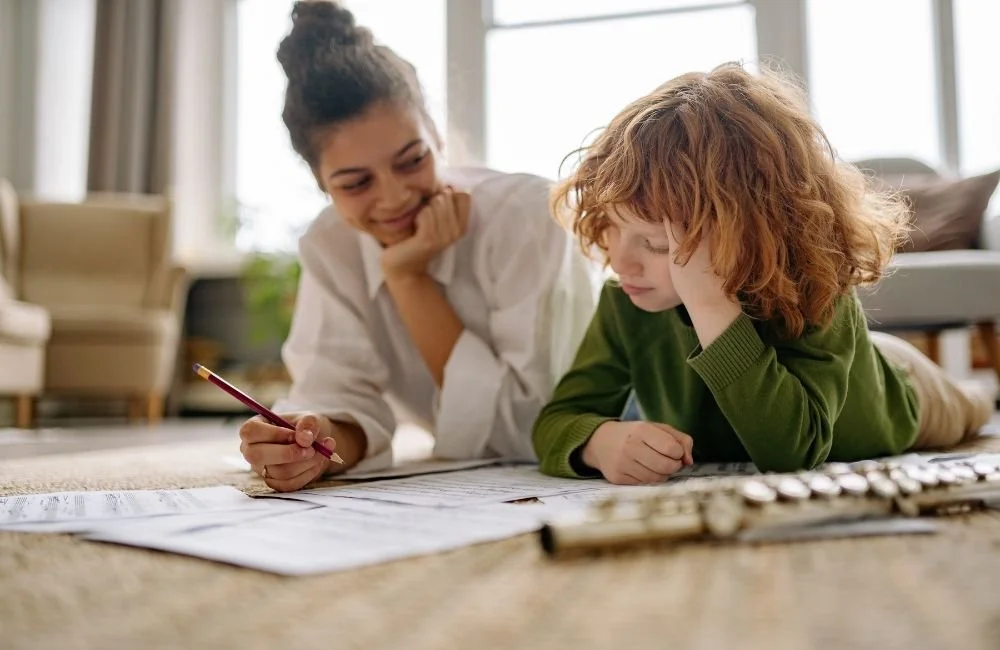
Supporting Focus at Home
As parents, we're often encouraged to keep children busy, offer stimulating activities, and make the most of every learning opportunity. But when it comes to developing concentration, doing a little less can sometimes be more valuable.
Protect moments of deep engagement.
When your child is absorbed in something, resist the urge to interrupt—even with praise. A well-intentioned "Wow, look what you made!" can sometimes pull a child out of the very concentration we're hoping to encourage. There will be time to admire their work afterward.
Create a calmer environment.
Children don't necessarily need a perfectly quiet room to focus, but too many competing choices can make it difficult to settle. Consider keeping a smaller selection of toys and activities accessible, with a designated place for each. A simple, organized environment makes it easier for children to choose something and remain engaged with it.
Make room for repetition.
It can be tempting to introduce something new once a child has successfully completed an activity. But children often repeat things because they're still discovering something through the process. What looks identical to us may involve small adjustments, growing precision, or a new understanding for them. Repetition isn't always a sign that a child needs a greater challenge.
Be mindful of transitions.
Imagine being halfway through something important when someone suddenly announces it's time to stop. Children can experience that same frustration. Whenever possible, give them advance notice before changing activities and allow time to reach a natural stopping point. This respects their concentration while helping them learn to manage transitions.
Let everyday life offer opportunities to concentrate.
Focus doesn't have to be practised through special activities. Washing vegetables, sorting laundry, watering plants, or helping prepare a meal can all invite sustained attention. These experiences are particularly meaningful because children can see the purpose behind what they're doing.
These small adjustments aren't about creating the perfect conditions or expecting children to concentrate all the time. They're about recognizing that attention is influenced by the environment we create, the pace we set, and the expectations we bring into everyday family life.
The Value of an Uninterrupted Moment
There is something easy to miss about childhood: children spend much of their day responding to the pace of adults.
We decide when it's time to leave, what comes next, when an activity should end, and when it's time to move on. Much of this structure is necessary, of course. But within those routines, children also need moments when they can follow their own train of thought without being hurried toward the next thing.
Imagine a child who has been quietly working for twenty minutes. They are so absorbed that they barely notice the activity happening around them. When they finally finish, they look at what they've done, perhaps sit with it for a moment, and then move on.
There may be no applause, no announcement, and no obvious achievement to celebrate.
Yet something important has happened. For those twenty minutes, the child has experienced what it feels like to give something their full attention.
And perhaps there's something for adults to learn from that moment, too.
We often measure a productive day by how much we accomplish, how many activities we fit in, or how quickly we move from one responsibility to the next. Children remind us that a meaningful experience doesn't always produce something we can point to. Sometimes its value lies in the depth of attention we bring to it.
At Orange Seeds Montessori, we believe childhood should make room for that kind of experience. Not every moment needs to be filled, directed, or measured by an outcome. Sometimes, allowing a child to become completely absorbed in something is valuable enough on its own.
After all, learning to focus is not only about learning how to work. It is also about discovering how much there is to experience when we give something our full attention.